The 2026 IRA contribution limits are higher, which is good news if you want to shelter a little more money from taxes this year. But most people only hear the headline number and miss the part that actually matters: whether they qualify for a Roth IRA, whether their Traditional IRA contribution is deductible, and how this fits with a 401(k) at work.
Here’s the plain-English version.
The 2026 IRA contribution limit
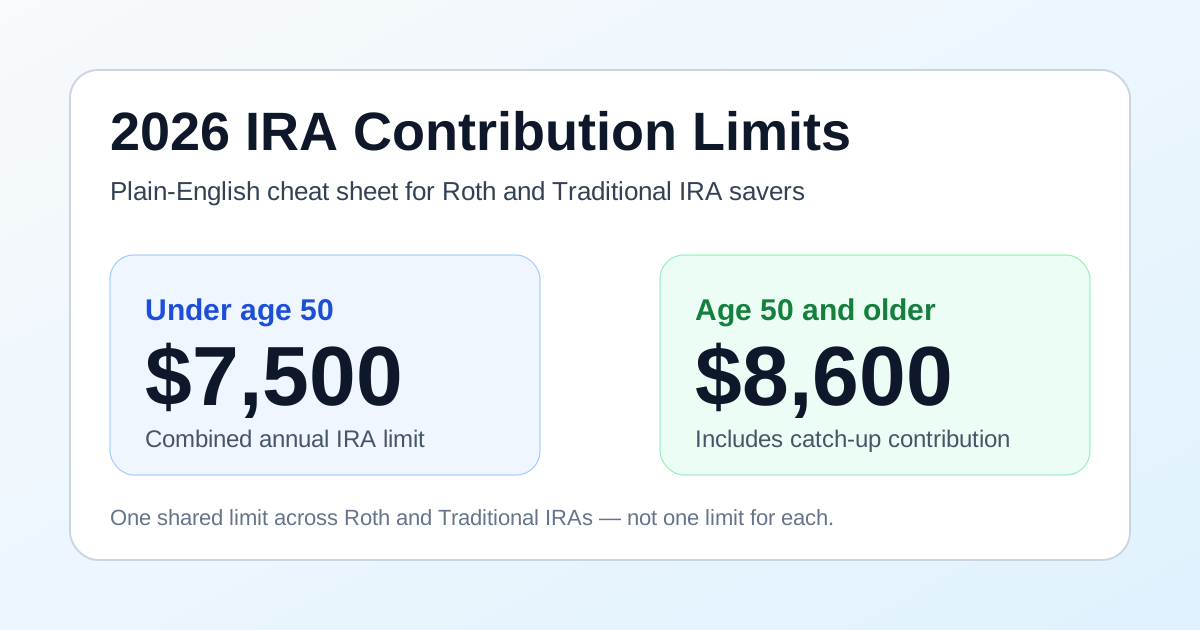
For 2026, the IRA contribution limit is $7,500 if you’re under age 50.
If you’re 50 or older, the limit is $8,600 because the usual $1,000 catch-up amount now includes an inflation adjustment.
That limit is combined across all of your IRAs. In other words, you do not get $7,500 for a Roth IRA and another $7,500 for a Traditional IRA. You get one total annual limit across both.
So these would all be allowed:
- $7,500 to a Roth IRA and $0 to a Traditional IRA
- $4,000 to a Roth IRA and $3,500 to a Traditional IRA
- $7,500 to a Traditional IRA and $0 to a Roth IRA
What you cannot do is contribute more than the annual combined cap.
If you’re still building your savings habits, don’t get hung up on maxing it immediately. Even smaller automatic contributions matter, especially once you understand how compound interest works.
What changed from 2025 to 2026?
In 2025, the IRA limit was $7,000 for people under 50 and $8,000 for people 50 and older.
In 2026, it increased to:
- $7,500 if you’re under 50
- $8,600 if you’re 50 or older
That’s a meaningful bump, especially for people who were already close to the limit. If you were auto-contributing $583 per month in 2025 to max out your IRA, you’d need to move that closer to $625 per month in 2026.
That small adjustment is easy to miss, and it’s exactly why retirement contributions are worth reviewing once a year instead of putting them on autopilot forever.
Roth IRA income limits for 2026
The 2026 IRA contribution limits apply to Roth IRAs too, but Roth eligibility depends on income.
For single filers in 2026:
- Full contribution if MAGI is under $153,000
- Partial contribution if MAGI is $153,000 to under $168,000
- No direct Roth IRA contribution if MAGI is $168,000 or more
For married filing jointly in 2026:
- Full contribution if MAGI is under $242,000
- Partial contribution if MAGI is $242,000 to under $252,000
- No direct Roth IRA contribution if MAGI is $252,000 or more
If you’re fuzzy on whether a Roth or Traditional IRA makes more sense, start with Roth IRA vs. Traditional IRA. That’s the real decision before the limit even matters.
Can you always deduct a Traditional IRA contribution?
No. This is where people get tripped up.
You can always contribute to a Traditional IRA if you have enough earned income, but you may not get a full tax deduction if you or your spouse are covered by a retirement plan at work.
For 2026, if you are covered by a workplace retirement plan, the deduction starts phasing out at:
- $81,000 to $91,000 MAGI for single filers
- $129,000 to $149,000 MAGI for married filing jointly
If you are not covered by a workplace plan, but your spouse is, the deduction phases out at:
- $242,000 to $252,000 MAGI for married filing jointly
If neither spouse is covered by a workplace retirement plan, the contribution is generally deductible up to the annual limit.
This is why a Traditional IRA is not automatically the “tax deduction account” people think it is. Sometimes it is. Sometimes it isn’t.
Which account should you prioritize in 2026?
The answer depends more on your tax picture than on the contribution limit itself.
Roth IRA usually makes more sense if:
- your income is moderate enough to qualify
- you expect your income to rise over time
- you want tax-free withdrawals later
- you want flexibility, since Roth contributions can be withdrawn tax- and penalty-free if needed
Traditional IRA usually makes more sense if:
- you qualify for the deduction
- you’re in a relatively high tax bracket now
- you expect to be in a lower bracket in retirement
- you want to reduce taxable income this year
If you also have a workplace plan, your order of operations often looks like this:
- Contribute enough to your 401(k) to get the full employer match if one exists
- Fund your IRA based on whether Roth or Traditional fits better
- Go back and increase your 401(k) if you still have room in your budget
If you need a refresher on the employer-plan side, read what a 401(k) is and how it works.
What if you can’t max the 2026 IRA contribution limit?
That’s normal. Most people don’t max it.
A better goal is to create a contribution level you can repeat every month without blowing up your cash flow. If you’re just getting started, even $100 a month is real progress. If that sounds more realistic than $625 a month, here’s how to invest your first $100.
What matters most is consistency. A person who contributes steadily for 20 years beats the person who reads finance content for 20 years and never starts.
Best places to open an IRA
For beginners, the right IRA provider is usually the one with:
- no account minimum or a very low one
- low-cost index fund options
- a simple interface
- no annual maintenance fee
Three strong editorial options are:
- Fidelity — beginner-friendly and strong on low-cost funds
- Vanguard — excellent for long-term index-fund investors
- Charles Schwab — simple setup and solid all-around brokerage option
Those are editorial recommendations only here — not paid placements. If you want the simplest possible investing approach after the account is open, broad low-cost index funds are usually the cleanest starting point. We cover the basics in Index Funds for Beginners.
Common mistakes with IRA contribution limits
1. Treating Roth and Traditional limits as separate
They aren’t. The annual cap is shared across your IRAs.
2. Contributing too much by accident
This often happens when someone has automatic deposits going into one IRA and then opens another one at a different broker. Excess contributions can trigger a 6% penalty each year until fixed.
3. Ignoring income limits
Roth IRA income rules and Traditional IRA deduction phaseouts are not side details. They’re the rules.
4. Waiting until next December to think about it
The best move is usually to spread contributions through the year, not scramble at the end.
The bottom line
The 2026 IRA contribution limits went up to $7,500 for most savers and $8,600 for people 50 and older. That’s useful — but the more important questions are whether you qualify for a Roth IRA, whether a Traditional IRA contribution is deductible, and whether your current budget can support consistent investing.
Don’t overcomplicate the first step. Pick the right account type, automate a realistic monthly contribution, and increase it when your income improves. That’s what actually moves the needle.
Related Reads
- Roth IRA vs. Traditional IRA: Which One Should You Pick? — the tax-tradeoff in plain English
- What Is a 401(k)? — how your workplace plan fits into the bigger retirement picture
- Index Funds for Beginners — what to buy after your IRA is open