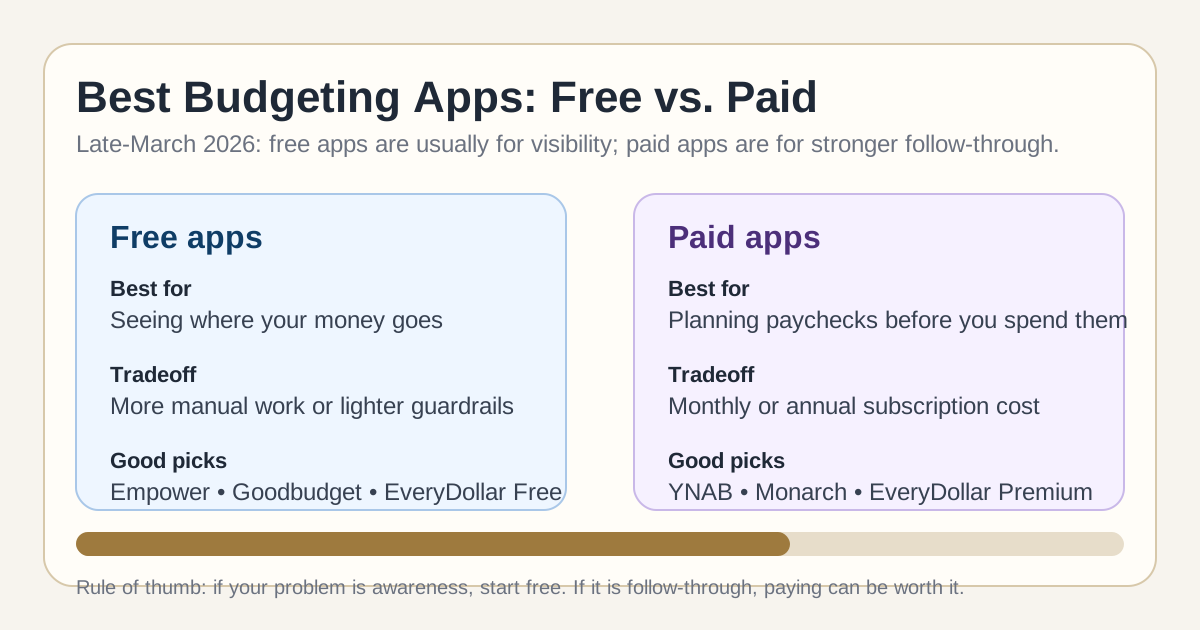
If you are looking for the best budgeting apps, start with this rule: free apps are usually enough if you mostly need visibility, while paid apps are worth it when you need structure, accountability, or shared planning.
That is the part people miss.
The real decision is not “free vs. paid.” It is passive tracking vs. active budgeting.
A free app can show you where your money went. A paid app is more useful when you want help deciding where your next paycheck should go before you spend it.
If you are still getting the basics in place, start with how to make a budget that you will actually stick to. If you already know you need a tool, here is the honest breakdown.
The quick picks
| App | Best for | Cost style | What to know |
|---|---|---|---|
| Empower | Seeing your full financial picture in one place | Free | Best if you want account aggregation, net worth tracking, and spending visibility |
| Goodbudget | Envelope budgeting without physical cash | Free + premium option | Best if you are okay with more manual entry |
| YNAB | Hands-on zero-based budgeting | Paid | Best if you want every dollar assigned a job before the month starts |
| Monarch Money | Couples or households who want one shared money hub | Paid | Best if you want budgeting, recurring bills, goals, and net worth in one app |
| EveryDollar | Simple zero-based budgeting | Free + premium option | Free version is basic; premium is what adds bank transaction import |
Free budgeting apps are best when your problem is awareness
A lot of people do not need a paid budgeting app on day one.
If your main problem is that you do not really know where your money is going, a free tool can be enough to fix that. The value is not fancy charts. The value is getting honest visibility fast.
That matters even more if you are trying to stop drifting through the month and wondering why nothing is left by payday. Our guide on how to stop living paycheck to paycheck covers the behavior side. A good free app can support that, but it will not do the work for you.
Empower: best free option for seeing the whole picture
Empower is strongest as a free dashboard.
It is a good fit if you want to connect your bank accounts, credit cards, loans, and investments and see everything in one place. If your real problem is that you keep making decisions with partial information, this kind of overview helps.
Where it is weaker: it is not really a strict zero-based budgeting tool. It is better for tracking and awareness than for assigning every dollar a job.
So if you want broad guardrails and a simpler framework, combine a free dashboard like Empower with the 50/30/20 budget rule. That pairing is easier for a lot of people than jumping straight into a more detailed app.
Goodbudget: best free option for envelope-style budgeting
Goodbudget is the best free choice if the envelope budgeting method clicks for your brain.
Instead of carrying literal cash envelopes, you create digital envelopes for categories like groceries, gas, eating out, or fun money. That makes it a good bridge between old-school cash discipline and modern app convenience.
The tradeoff is simple: the free version is more manual. For some people that is annoying. For other people, the manual step is exactly what creates awareness.
If the envelope idea already resonates with you, this is a cleaner fit than a dashboard-style app.
EveryDollar Free: best if you want simple zero-based structure
EveryDollar is a reasonable free option if you want a simpler zero-based budget and do not mind doing more of the transaction work yourself.
The free version lets you build the plan. The premium tier is what adds bank syncing and more automation.
That means EveryDollar Free works best for people who want the discipline of a zero-based setup but are not ready to pay yet.
Paid budgeting apps are best when your problem is follow-through
This is where paying can be worth it.
If you have already tried budgeting and the issue is not understanding the concept but actually sticking with it, a paid app can earn its keep.
You are usually paying for some combination of:
- less manual entry
- stronger planning tools
- recurring bill and subscription visibility
- shared household budgeting
- better reports and goal tracking
- a workflow you are more likely to keep using
That said, paying does not magically fix avoidance. A paid budgeting app still fails if you never open it.
YNAB: best paid option for true zero-based budgeting
YNAB is still the strongest paid choice if you want a real zero-based budgeting system.
Its whole philosophy is that every dollar gets a job. That makes it a strong fit for people who want to plan ahead, stay tight on spending categories, and make tradeoffs consciously instead of reacting afterward.
As of late March 2026, YNAB lists pricing at $109 per year or $14.99 per month, with a free trial. That is not cheap for a budgeting app. But for the right person, it is not really an app purchase. It is a behavior-change tool.
If that planning style appeals to you, read the zero-dollar budget method explained too. YNAB fits that mindset better than almost anything else.
Monarch Money: best paid option for households and flexibility
Monarch Money is the best paid choice if you want a more flexible all-in-one money hub.
It is especially good for couples or households because it combines budgeting, account aggregation, recurring expense tracking, reports, goals, and a shared view of your finances. Monarch also gives you more than one way to budget, which is useful if you do not want to live inside a strict zero-based system every single day.
At the time of writing, Monarch lists pricing at $99.99 per year or $14.99 per month.
This is the app I would point people toward when they say something like: “I do not just need a budget. I need one place where my partner and I can actually see everything and make decisions together.”
EveryDollar Premium: best if you want zero-based budgeting with more automation
EveryDollar Premium is the upgrade path if you like the EveryDollar structure but do not want to enter everything by hand.
According to Ramsey Solutions, premium adds automatic transactions, debt payoff tracking, and more guidance around finding margin in your budget.
That makes it a more serious option for people who want zero-based budgeting but prefer a slightly more straightforward workflow than YNAB.
Free vs. paid budgeting apps: what you are really paying for
The honest answer is that most people are not paying for “features.” They are paying for friction reduction.
A free app can absolutely work if you are already disciplined.
But paid apps become more useful when you need one or more of these:
1. You budget with a partner
Shared visibility is a real feature, not a cosmetic one.
If one person is checking balances and the other is spending from memory, the budget breaks fast. Household collaboration is one of the clearest cases where paying for the right app can be worth it.
2. Your income or spending is messy
If your income changes month to month, or if you have a lot of recurring bills, subscriptions, reimbursements, or category drift, more automation helps.
3. You need more than a rearview mirror
Some people do fine with simple tracking. Others need the app to push them into making a plan before the month starts.
That is the difference between “interesting spending history” and a real budgeting system.
Which app fits your budgeting style?
Pick based on how you think, not on which app has the loudest marketing.
If you want a simple overview
Pick Empower.
Best for people who want one place to see accounts, net worth, and spending trends without committing to a strict budgeting workflow.
If you want envelope budgeting
Pick Goodbudget.
Best for people who overspend in a few categories and need stronger category walls.
If you want every dollar assigned before the month starts
Pick YNAB.
Best for people who want a full planning system, not just after-the-fact tracking.
If you want a polished all-in-one app for a household
Pick Monarch Money.
Best for couples, families, or anyone who wants budgeting plus a broader financial dashboard.
If you want zero-based budgeting without too much complexity
Pick EveryDollar.
Best for people who want a simpler tool and are okay with fewer customization layers.
When free is enough
A free budgeting app is usually enough if:
- your spending is fairly stable month to month
- you mostly need visibility, not coaching
- you are fine checking in once or twice a week
- you are using a simple system already
- you are still proving to yourself that you will budget at all
If that is you, do not overcomplicate this. Start simple. A cleaner system you actually use beats a premium app you abandon after ten days.
When paid is worth it
A paid budgeting app is usually worth it if:
- you keep falling off the budget after the first week
- you are combining finances with a partner
- you want a real zero-based system
- you have a lot of recurring expenses or noisy transactions
- you are actively trying to pay off debt or change spending behavior
In other words: if the app helps you save more than it costs, the subscription is not the problem.
My actual recommendation
If you are unsure, do this:
- Start with Empower if you mainly want visibility.
- Start with Goodbudget if envelope budgeting sounds right.
- Pay for YNAB if you want to be highly intentional with every dollar.
- Pay for Monarch Money if you want a shared household dashboard with budgeting built in.
- Use EveryDollar if you want zero-based budgeting but want something simpler than YNAB.
The biggest mistake is paying for a budgeting app whose philosophy does not match how you actually operate.
A dashboard is not the same as a planning system. A planning system is not the same as a shared household app. And none of them will fix avoidance on their own.
Bottom line
The best budgeting apps are not “best” in the abstract.
They are best for a specific job.
- choose a free app if you need awareness and a lighter starting point
- choose a paid app if you need stronger structure, shared planning, or better follow-through
If you are trying to decide in one sentence: start free unless you already know that behavior change — not visibility — is the part you struggle with.
Related Reads
- How to Make a Budget That You’ll Actually Stick To — the practical starting point if you need the system before the software
- The 50/30/20 Budget Rule Explained — a simpler budgeting framework if you do not want high detail
- The $0 Budget Method That Actually Works — the better fit if you want every dollar assigned a job