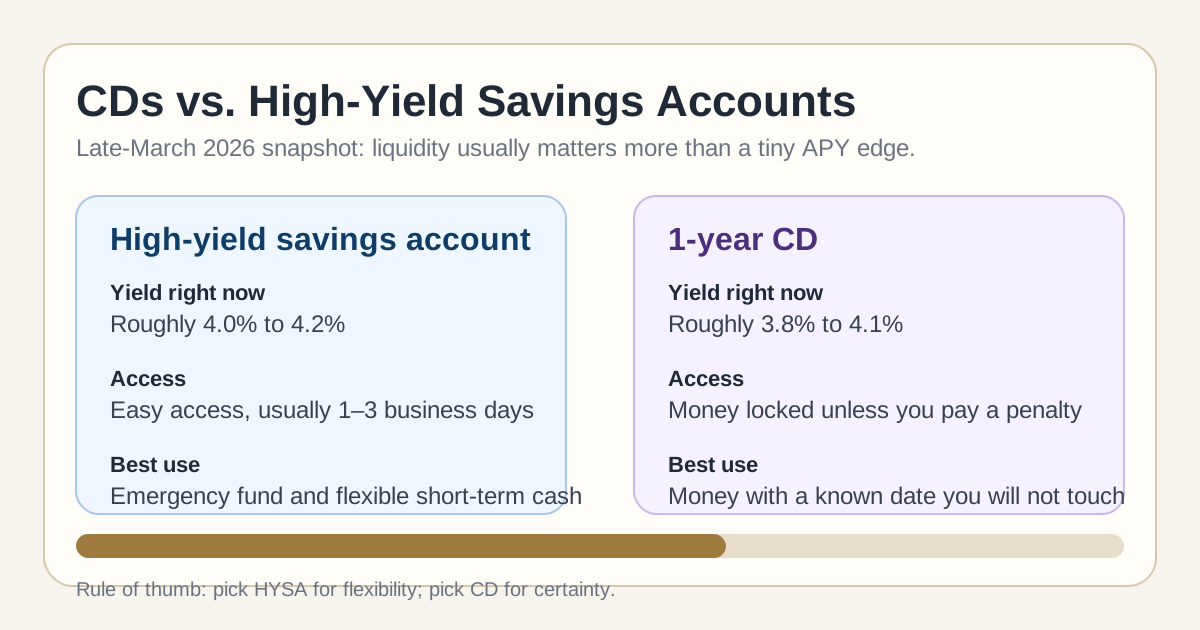
If you are comparing CDs vs. high-yield savings accounts right now, the short answer is this:
- choose a high-yield savings account if you might need the money soon
- choose a CD if you know you will not touch the money before the term ends
That sounds obvious, but in the current rate environment it matters even more.
In late March 2026, top high-yield savings accounts are still paying around 4%, and top 1-year CDs are also in roughly that same neighborhood. In other words, the rate gap is often small enough that liquidity matters more than people think.
So this is usually not a question of “which one earns way more?”
It is a question of what job this money has.
The quick answer
Here is the plain-English version:
A high-yield savings account is usually better if:
- this is your emergency fund
- you are still building the balance gradually
- you might need the money in the next few months
- you care more about flexibility than locking a rate
- the CD rate is only a little higher anyway
If you need a refresher on how these accounts work, start with what a high-yield savings account is.
A CD is usually better if:
- you have cash you know you will not need before a specific date
- you want to lock in a fixed rate
- you think savings rates may drift lower later this year
- you already have enough liquid cash outside the CD
- you are saving for a goal with a clear timeline, like tuition due in 9 months or a planned tax payment buffer
What is the difference between a CD and a high-yield savings account?
A high-yield savings account is a savings account with a variable rate. You can usually move money in or out when needed, though transfers may take a day or two.
A CD — certificate of deposit — is a time deposit. You agree to leave the money there for a set term, like 6 months, 12 months, or 18 months. In exchange, the bank usually gives you a fixed APY for that term.
The key tradeoff is simple:
- HYSA = more access
- CD = more certainty
CDs vs. high-yield savings accounts in March 2026
Right now, the spread is not dramatic.
A useful snapshot of the late-March 2026 market looks roughly like this:
| Feature | High-yield savings account | 1-year CD |
|---|---|---|
| Top current rates | roughly 4.0% to 4.2% | roughly 3.8% to 4.1% |
| Access to money | easy, usually 1 to 3 business days | limited until maturity unless you pay a penalty |
| Rate type | variable | fixed |
| Best use | emergency fund, flexible short-term cash | known timeline money you will not need early |
| Main downside | rate can fall | early withdrawal penalty / less flexibility |
That is why many people are overestimating the case for CDs right now.
If a CD is paying only a tiny bit more than a good savings account, locking up your money may not be worth it.
If you want current bank-specific context, our guide to the best high-yield savings accounts in 2026 is the better place for that.
When a high-yield savings account is the better move
For most people, a high-yield savings account is still the default winner.
1. Your emergency fund belongs there
This is the biggest one.
If the money exists to protect you from job loss, car repairs, surprise medical bills, or the kind of week that goes sideways fast, a CD is usually the wrong home for it.
Yes, you can break a CD early and take the penalty. But that is still friction you do not need on emergency money.
That is why our article on where to keep your emergency fund still points most people toward a HYSA first.
2. The rate gap is often too small to matter much
A lot of people hear “CD” and assume it must pay meaningfully more.
Sometimes that is true.
Right now, often it is not.
If you are deciding between 4.00% in a HYSA and 4.10% in a 1-year CD, the extra return is real but not life-changing.
On $10,000, that is roughly a $10 difference over a year before tax.
That does not mean CDs are pointless. It means you should not give up flexibility for almost nothing.
3. You are still actively adding to the balance
A HYSA works better when the money is still moving.
If you are building your emergency fund, adding to a home down payment fund every paycheck, or keeping a medium-term cash buffer, the simplicity of a savings account usually beats opening multiple CDs every time you save more.
When a CD is the better move
A CD makes more sense when the timeline is genuinely known.
1. You want rate certainty
A good CD locks your APY for the whole term.
That matters if you think savings rates may slide lower later in 2026. A HYSA rate can move down whenever the bank decides to adjust it. A CD rate usually stays fixed until maturity.
If predictability matters more to you than access, that certainty has value.
2. This money is not your first line of defense
A CD works better when you already have enough liquid cash elsewhere.
Example:
- emergency fund in a HYSA
- checking buffer for normal surprises
- extra cash for a known goal in a 9- or 12-month CD
That is a much stronger setup than putting all your short-term cash into CDs and telling yourself you can always break them if needed.
3. You have a specific date in mind
A CD can be a clean match for money you expect to use on a known schedule, like:
- estimated taxes
- tuition due next semester
- a planned move
- a wedding payment
- a car purchase you expect to make in several months
If the date is real and the funds are not emergency money, a CD is more compelling.
The mistake people make with CDs
People often ask the wrong question.
They ask:
- “Which one pays more right now?”
The better question is:
- “What happens if I need this money sooner than expected?”
That is why CDs are usually a secondary cash tool, not the default home for all your savings.
The same problem shows up when people try to over-optimize emergency cash instead of first figuring out how much their emergency fund should be.
A simple, boring setup usually beats a clever one you have to mentally babysit.
What about no-penalty CDs?
This is the middle-ground option.
A no-penalty CD can make sense if:
- you want a fixed rate
- you may want the option to access the money
- the rate is competitive with regular CDs and HYSAs
The catch is that not every no-penalty CD is actually worth it. Sometimes the rate is lower enough that you are better off just keeping the money in a good HYSA.
Still, if you like the idea of optionality, this can be the one CD category worth a closer look.
Best choice by goal
If you want the shortest practical guide, use this:
Emergency fund
Best choice: high-yield savings account
Down payment within the next year
Usually best: mostly HYSA, maybe a CD for the portion you definitely will not need early
Sinking fund for a known expense 6 to 12 months away
Often best: CD, if the maturity date matches the timeline
Cash you are still contributing to every month
Best choice: high-yield savings account
Cash you want fully liquid but earning something
Best choice: high-yield savings account
Cash you want to lock at a fixed rate because you expect falling savings yields
Often best: CD
So, which is better right now?
For most people, a high-yield savings account is still better right now.
Not because CDs are bad.
Because in the current environment, the extra yield from many CDs is often too small to justify giving up flexibility — especially for emergency savings or any money with uncertain timing.
A CD becomes the better answer when you can say, clearly and honestly:
- I will not need this money early
- I already have liquid cash elsewhere
- locking the rate matters to me
If you cannot say all three, a HYSA is probably the cleaner choice.
Bottom line
If you are deciding between CDs vs. high-yield savings accounts, use this rule:
- pick a HYSA for flexibility
- pick a CD for certainty
Right now, because rates are fairly close, most people should not lock up money just to chase a tiny APY edge.
Keep your emergency fund liquid. Keep your short-term cash simple. Use CDs for money with a real timeline, not just because the acronym sounds more sophisticated.
Related Reads
- What Is a High-Yield Savings Account and Should You Get One? — the evergreen explainer on how HYSAs work
- Best High-Yield Savings Accounts in 2026 — current rate context if you want specific account comparisons
- Where Should You Keep Your Emergency Fund? — the practical guide for deciding where your cash buffer should live