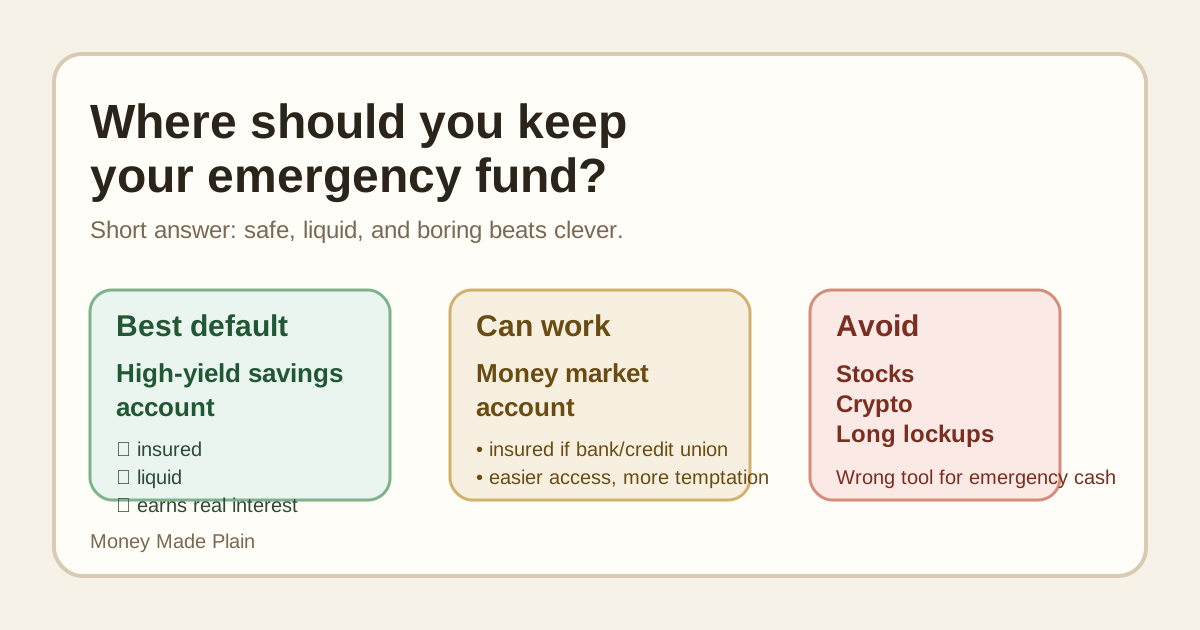
If you are asking where to keep your emergency fund, the short answer is: somewhere safe, liquid, and boring.
For most people, that means a high-yield savings account. Not stocks. Not crypto. Not your checking account if you know you’ll slowly spend it. And usually not a long-term CD either.
Your emergency fund has one job: be there when life gets expensive fast. The right account protects the money, earns at least some interest, and lets you get to it without drama.
The best place for most people: a high-yield savings account
A high-yield savings account is still the default best answer in 2026.
Why?
- Safe: FDIC- or NCUA-insured when held at a covered bank or credit union
- Liquid: usually accessible within 1 to 3 business days
- Better yield than a regular savings account: many top accounts are still paying around 4% or more, while traditional savings accounts are often far lower
- Simple: no investing decisions, no lockup, no weird tax treatment
If you already read our guide to what a high-yield savings account is, this is the practical follow-up question. The emergency fund is exactly the kind of money a HYSA is for.
A good setup is often:
- checking account for bills and normal spending
- HYSA for your emergency fund and short-term savings
- retirement and brokerage accounts for long-term investing
That separation matters. If your emergency fund lives in the same checking account you use for groceries, it is easier to blur the line between “real emergency” and “I had a rough week.”
What an emergency fund account needs to do
Before comparing account types, here is the actual standard:
1. It has to be safe
Emergency money is not money you should be trying to maximize with risk. You are not trying to beat the market with this cash. You are trying to make sure a job loss, ER bill, or surprise car repair does not force you into debt.
That is why the best home for an emergency fund is usually an account with FDIC or NCUA insurance, not a stock fund or anything that can drop right when you need it.
2. It has to be easy enough to access
You do not need your emergency fund to be instantly spendable every second of the day. But you also do not want it tied up somewhere that creates a penalty, settlement delay, or major friction.
A little friction is actually useful. It can stop impulse spending. But not so much friction that getting your own money during a real emergency becomes a second emergency.
3. It should earn something
Your emergency fund is not an investment account, but it also does not need to earn 0.01% out of habit.
Even if rates drift down as the Fed cuts over time, there is still a big difference between “basically nothing” and “a reasonable cash yield.” In March 2026, top savings accounts are still materially above the national average, which is exactly why it is worth being intentional about where this money sits.
If you are still building your cash cushion, start with our guide on how much your emergency fund should be so you know the size target before optimizing the account.
Option 1: High-yield savings account
This is the best choice for most people.
Best for: a standard 3- to 6-month emergency fund, people who want simplicity, anyone still building savings.
Pros:
- easy to understand
- no market risk
- no lockup period
- usually strong rates compared with regular savings
- good mental separation from checking
Cons:
- transfers may take a day or two
- rates are variable, so they can fall
- some banks still have withdrawal rules or clunky transfer systems
If your emergency fund is straightforward — just cash you may need in the next few months if something goes wrong — stop here. A HYSA is usually enough.
Option 2: Money market account
A money market account can also work well for an emergency fund.
This is a bank product, not the same thing as a money market mutual fund inside a brokerage account.
Best for: people who want emergency savings with easier access features like checks or a debit card.
Pros:
- often FDIC- or NCUA-insured
- can pay rates similar to a HYSA
- sometimes comes with check-writing or debit access
Cons:
- rates are not always better than a HYSA
- minimum balance requirements can be higher
- easier access can make it easier to spend casually
A money market account makes sense if you want slightly faster access than a separate online savings account gives you, but still want insured cash.
The tradeoff is behavioral: the more your emergency fund feels like spending money, the less clean the boundary becomes.
Option 3: A split setup
This is my favorite setup for people with a larger emergency fund.
Example:
- keep $1,000 to $3,000 in a local savings account or a linked bank account for immediate surprises
- keep the rest in a high-yield savings account
That way, if you need money today, some of it is close. But the bulk of the fund is still parked in a place that earns more and is less tempting to raid.
This works especially well if you are the kind of person who worries about transfer delays from an online bank but also knows that leaving the whole fund in checking is a mistake.
If cash flow is tight and you are still trying to get off the treadmill, pair this with how to stop living paycheck to paycheck. A separate emergency fund works much better once your monthly money flow is not chaos.
Option 4: CD ladder or no-penalty CD
This is where people overdo optimization.
Yes, a CD can sometimes pay a better rate than a savings account. And yes, if rates are falling, locking part of your emergency fund into a decent CD can look smart.
But the main question is not “can I squeeze out a little more yield?” The main question is “will I regret this if I need the money at the wrong time?”
A CD is only reasonable for emergency-fund money if:
- your emergency fund is already fully built
- you have enough liquid cash outside the CD for immediate problems
- the CD has no penalty or only a small penalty
- you understand exactly how access works
For most people, a full emergency fund in CDs is unnecessary friction. A small slice in a no-penalty CD can be fine. Making the whole thing less liquid usually is not.
If you are actively weighing both account types, read CDs vs. high-yield savings accounts for the current rate-environment tradeoff in plain English.
What about a brokerage cash account or money market mutual fund?
This is where the answer gets more nuanced.
A brokerage settlement fund or money market mutual fund can be a reasonable place for part of an emergency fund if you fully understand the tradeoff. These options can offer competitive yields, but they are not the same as a bank savings account.
The big distinction: a bank savings account or insured money market account typically has FDIC or NCUA insurance. A money market mutual fund is an investment product, not a bank deposit, even if it is low-risk.
That does not automatically make it wrong. It just means it is not the clean, default answer for someone who wants the safest plain-English option.
If you like using a brokerage for cash management, keep the explanation simple in your own head: emergency cash belongs in the safest, clearest bucket first. Optimization comes second.
Where you should not keep your emergency fund
In stocks or stock funds
If the market drops 25% the same month you lose your job, that is not bad luck. That is a predictable mismatch between the job of the money and the place you put it.
Emergency money is not long-term money.
In crypto
No.
In your everyday checking account
A tiny starter buffer there is fine. Your full emergency fund usually should not live there.
Checking accounts tend to pay very little, and the money is too easy to absorb into normal spending.
In cash at home
A small amount of physical cash for a local disruption is reasonable. A full emergency fund in cash is not. It earns nothing, can be lost or stolen, and is easy to mentally treat like untracked money.
So where should you keep your emergency fund in 2026?
For most people:
- Keep the bulk of it in a high-yield savings account
- Optionally keep a small immediate-access slice closer to checking
- Use a money market account only if its access features genuinely help you
- Use CDs only for part of the fund, and only if you already have enough liquid cash
That is not the most exciting answer. Good. Your emergency fund should be boring.
The goal is not to build the cleverest cash-management system on the internet. The goal is to make sure one bad week does not become new debt.
Bottom line
If you are deciding where to keep your emergency fund, use this rule:
- safe first
- accessible second
- yield third
For most households, that points straight at a high-yield savings account.
Keep it separate. Keep it insured. Keep it boring enough that you do not touch it unless life actually punches first.
Related Reads
- How Much Should Your Emergency Fund Be? — figure out the right target before choosing the account
- What Is a High-Yield Savings Account and Should You Get One? — why HYSAs are the default best home for cash
- Best High-Yield Savings Accounts in 2026 — current-rate context if you want to compare account options